

zsty.us

Before / After · Case Study

Top Dog Tents — a tent shop that can finally answer 'will it fit my truck?'

  • Local Pro Services

Mark's rooftop-tent and overland-gear shop in Fullerton listed the tents but left the one question every buyer has — will this fit my vehicle, and can my roof carry it? — to phone calls and guesswork. The rebuilt store answers it on every product page with careful, sourced safety checks, and where a real answer isn't possible it says so and hands the buyer to a human instead of guessing.

A rooftop tent over a roof's rating puts two sleeping adults on the failure mode. The fitment rules live in code, not in copy.
🔒topdogtents.oglife.app
jackiej.events — modern site

At a glance

What this rebuild covers.

  • Agents

    The fitment checker is deliberately cautious and its safety rules can't be overridden from the page: a missing roof rating routes the buyer to a human, the weaker limit between roof and rack always wins, and every answer says where its numbers came from and what to double-check in the owner's manual.

  • Design

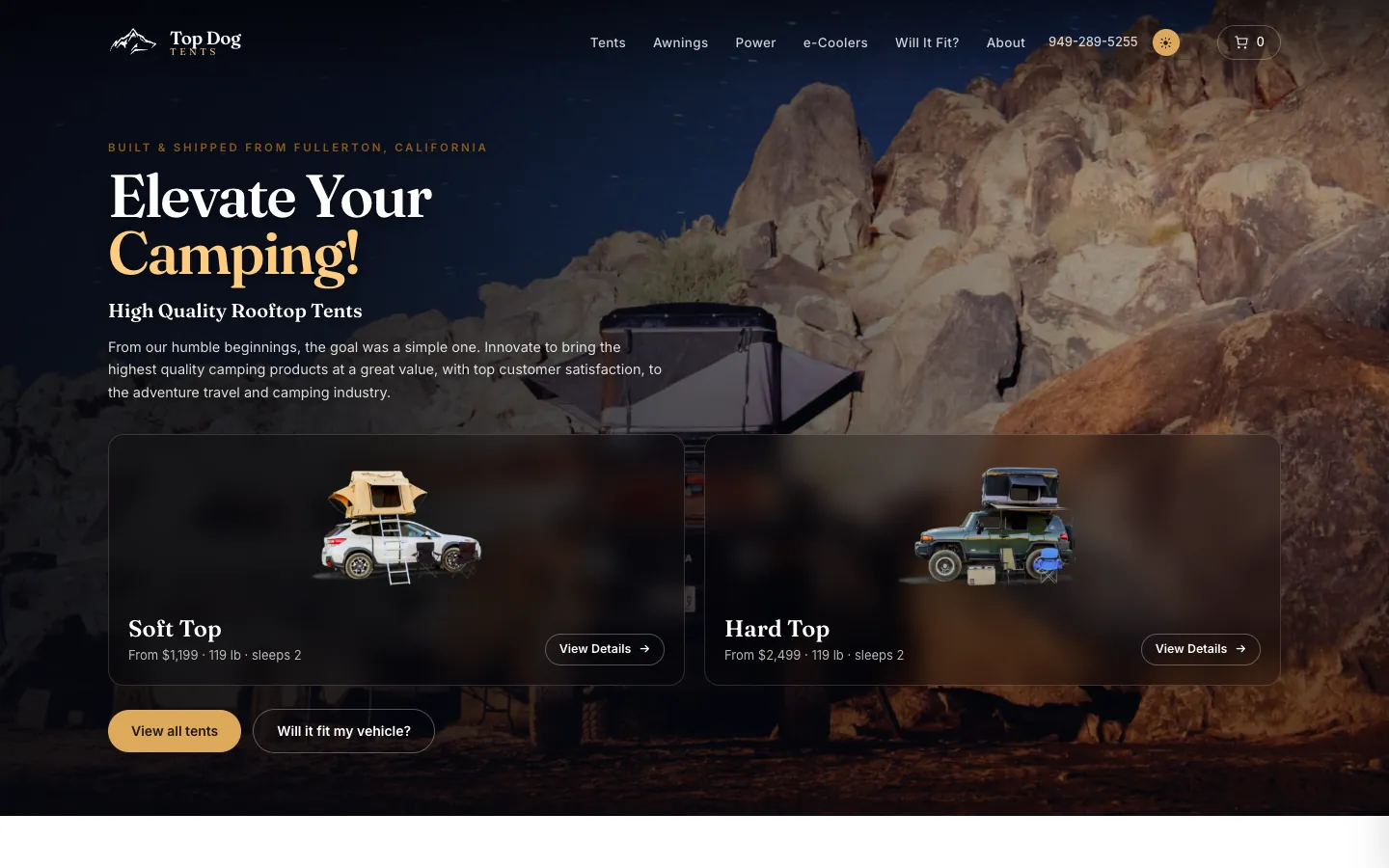
    Everything on the site — prices, weights, dimensions, photos, the logo — came straight from their old store; where the maker doesn't publish a figure the page says 'not published' instead of making one up, and the stale seasonal discount banner was deliberately left behind.

  • Selling & payments

    Checkout is an honest quote request rather than a card form, because freight on a 200-pound tent genuinely can't be priced until there's an address — a person confirms fit and shipping before any money moves.

  • Search visibility

    No invented star ratings are fed to search engines — the shop has four real named testimonials and nothing more is claimed — and the rebuild stays hidden from search until the real domain points at it, so the existing store's standing is never split.

The pixel diff

Overview, then the walkthrough.

Left: everything the legacy site shipped — frozen in place. Right: an auto-scrolling tour of the rebuild, from hero to booking. No slider to fight with.

Before — the overview
🔒topdogtents.com
Before — the overview

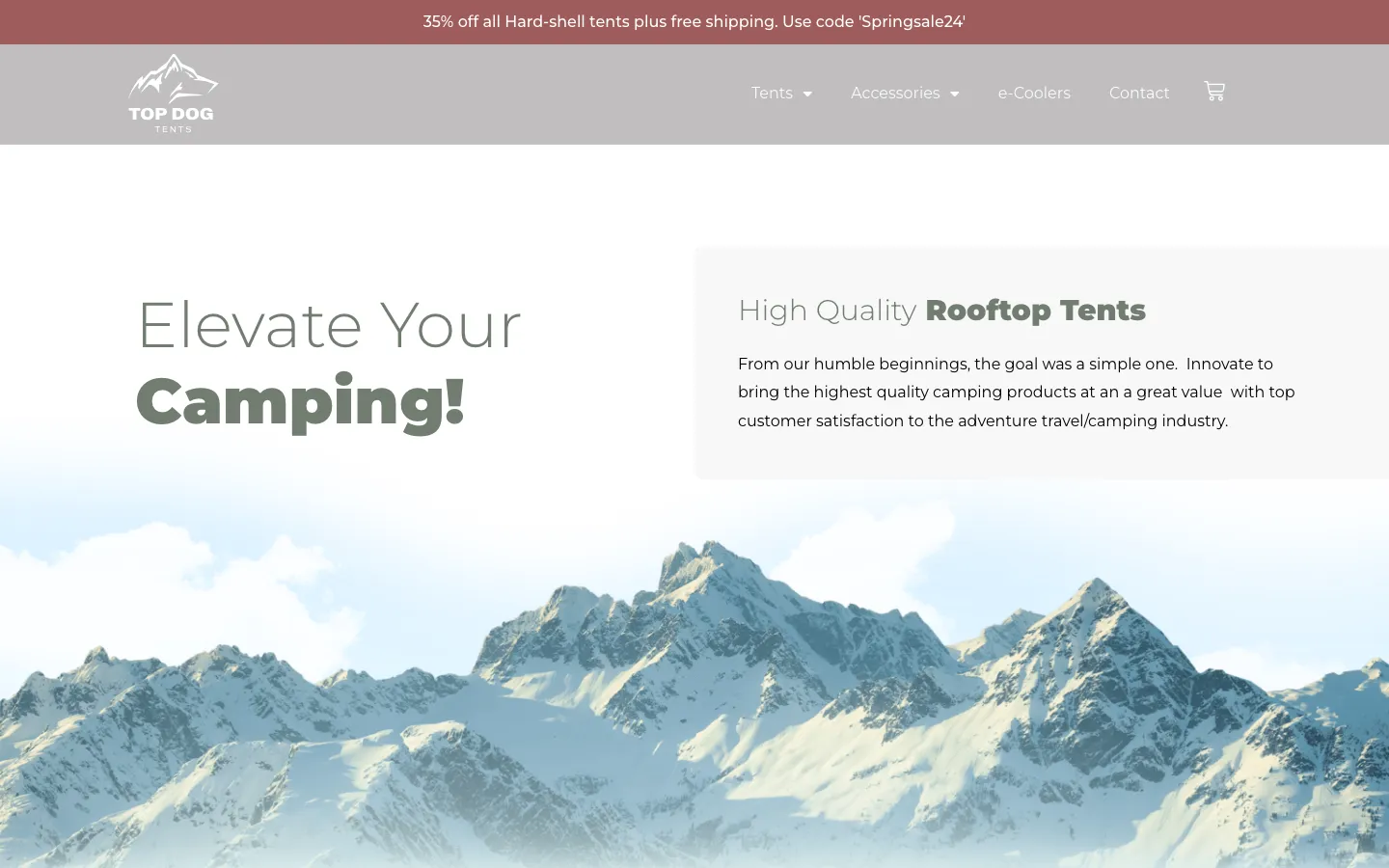
This is everything the legacy site had to offer above the fold. No pricing, no calendar, no booking — the funnel ended at a mailto.

After — scroll through what shipped
🔒topdogtents.oglife.app
After — scroll through what shipped

Auto-scrolls through the modern site so you can see the booking surface, the package grid, the pricing table, and the calendar inline — without leaving this page.

The four beats

Problem · Insight · Build · Outcome.

Scroll past the legacy frame. The four beats land in order. At the end, the modern site fades into the same window.

🔒topdogtents.com
Legacy
01 · Problem

A catalog behind an aging store, and a safety question nobody answers.

The old WordPress + WooCommerce store listed the tents but left the hard question — which tent fits which vehicle — to phone calls and forum guesswork, with a seasonal discount banner from a past sale still hanging on the homepage.

02 · Insight

In this category, the fitment answer is the product.

Everyone sells similar tents. The store that can say 'here is what your roof is rated for, here is which limit bound the result, here is what to verify in your manual' earns the order — and that answer has to be conservative, sourced, and impossible to override from the UI.

03 · Build

Extract everything, invent nothing.

The entire catalog — every price, weight, dimension, spec and image — was extracted from the old store's public product API in one pass. The fitment engine and its public roof-load dataset were built on top, on our hosting platform, with unpublished figures marked instead of fabricated.

04 · Outcome

Live on a temporary domain, indexing held for cutover.

The site is live now. A short punch list of unpublished figures — net weights, hardware weights, bar spreads, mounting-channel dimensions — sits with Mark; each one closed upgrades a soft fitment answer to a hard one. Indexing stays gated until the brand domain points here, so the rebuild never splits authority with the legacy store.

🔒topdogtents.oglife.app
Modern
For the technically curiousHow it was done
  1. 01

    Where it started

    The old store ran on WordPress + WooCommerce. It listed the rooftop tents, awnings, solar gear and 12-volt fridges, but the hard question — which tent fits which vehicle, and what the roof is actually rated to carry — was answered by phone calls and forum guesswork. A '35% off' banner from a past season was still hanging on the homepage.

  2. 02

    The insight

    Everyone in this category sells similar tents. The store that can say 'here is what your roof is rated for, here is which limit bound the result, here is what to verify in your manual' earns the order — and that answer has to be conservative, sourced, and impossible to override from the page.

  3. 03

    Extract everything, invent nothing

    The entire catalog — every price, weight, dimension, spec and image, plus the shop's own photography and logo — was pulled from the old WooCommerce store's public product API in one pass and rebuilt as a typed catalog on our hosting platform. Where Top Dog doesn't publish a figure, the page renders 'not published' rather than a fabricated number, and no aggregate review markup is emitted because no verified review system exists.

  4. 04

    The fitment engine

    A rooftop tent raises the centre of gravity and puts two sleeping adults on the mounting points, so every rule lives in code: a missing capacity means ask a human, never pass; a vehicle's static roof rating is never derived from its dynamic rating (that shortcut is a rack-maker guideline, and applying it to a vehicle roof is the most dangerous mistake available here); the ladder is never credited as load-bearing; clamp feet and unsupported raised rails hard-fail before any arithmetic runs; and the lower of the rack and vehicle rating always binds — the result says which one did. A public roof-load-ratings dataset ships with the site, and every pass names its data source and tells the buyer what to verify in the owner's manual.

  5. 05

    What runs now

    The site is live on a temporary address with checkout as a quote request — tents ship LTL freight where cost isn't knowable until there's an address, so a human confirms fit and freight before anything is charged. A short punch list of unpublished figures sits with the owner; each one he closes upgrades a soft fitment answer to a hard one. Search indexing stays gated until the brand domain cuts over, so the rebuild never competes with the legacy store.

Before

  • WordPress + WooCommerce
  • Stale '35% off' banner from a past season still up
  • No fitment guidance — customers guess or call

After

  • Modern app framework
  • Our hosting platform
  • Typed catalog — every spec sourced, gaps marked
  • Safety-first vehicle-fitment engine
  • Indexing gate for the temporary domain

What changed, with evidence

Agent backbone

The fitment engine: safety rules the UI cannot override

A rooftop tent raises the centre of gravity and loads the mounting points with two sleeping adults on top, so the engine is deliberately conservative and every rule is enforced in code: a missing capacity means ask a human, never pass; a vehicle's static rating is never derived from its dynamic rating (that shortcut is a rack-maker guideline, and applying it to a vehicle roof is the most dangerous mistake available here); the ladder is never credited even though it really does carry load; clamp feet and unsupported raised rails hard-fail before any arithmetic runs; and the lower of the rack and vehicle rating always binds — the result says which one did.

Before
Which tent fits which truck was a phone call and a guess.
After
A sourced, conservative answer on every product page — or an explicit handoff to a human.
  • Every pass names its data source and instructs the buyer to verify against the owner's manual
  • A public roof-load-ratings dataset ships with the site
  • Hard-fail checks run before any capacity arithmetic
Design

Honest by construction

Everything on the site was extracted from Top Dog's old WooCommerce store — prices, weights, dimensions, specs, their own product photography and logo. Where a figure isn't published, the UI renders 'not published' rather than a fabricated number. No star ratings are invented (Top Dog has four named testimonials and no verified review system, so no aggregate-rating markup is emitted), and the stale seasonal discount banner was deliberately not carried over.

  • Missing figures render 'not published' — the behavior is load-bearing, not cosmetic
  • No invented review scores anywhere in the markup
  • Known data gaps tracked as a punch list for the owner — each one closed turns a soft answer into a hard one
Retention

Checkout that respects a freight product

No card capture. Tents ship LTL freight where cost genuinely isn't knowable until there's an address, and fitment gets confirmed before anything ships — so checkout is a quote request that a human answers. Taking card details behind a form that doesn't charge would be worse than honest friction.

Design

The brand mark survived the shrink

The icon set and social image are generated from Top Dog's own logo glyph — a dual-image mark where a mountain range is also a dog's head in profile. At favicon sizes the real mark's fine negative space turns to mush, so the small sizes use a simplified peak; the full mark appears everywhere it has room to breathe.

← All rebuilds

Top Dog Tents — a tent shop that can finally answer 'will it fit my truck?' — zsty.us